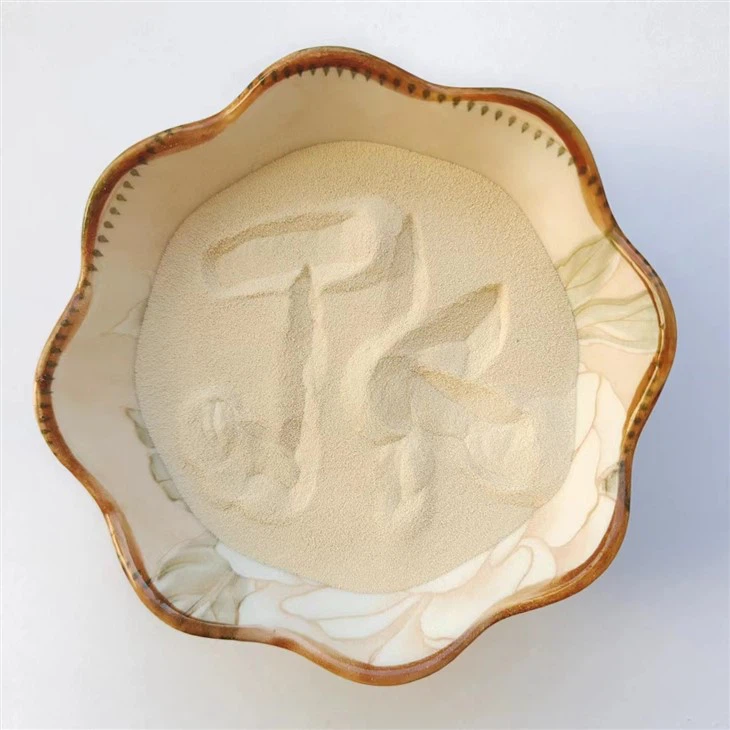
Products Description of Dispersant NNO Equivalent TAMOL NN9104 For Agricultural Pesticide
A dispersant refers to a type of substance that can prevent the aggregation of solid particles in a solid-liquid dispersion system during the processing of pesticide formulations, allowing the solid particles to remain uniformly dispersed in the liquid phase for a long time. Dispersant NNO Equivalent TAMOL NN9104 For Agricultural Pesticide are the most important, commonly used, and extensively utilized type of pesticide additives. Modern chemical pesticide products are actually dispersion systems containing the active ingredients of pesticides. To prepare such dispersion systems, most often dispersing additives are required. For example, the processing of pesticide formulations such as wettable powders, emulsifiable concentrates, granules, suspensions, emulsions, water-dispersible granules, milk powder, microcapsule suspensions, etc., all cannot do without dispersants. When adding Dispersant NNO Equivalent TAMOL NN9104 For Agricultural Pesticide and suspending agents during the preparation of emulsifiable concentrates and wettable powders, it is easy to form dispersion liquids and suspensions. Therefore, Dispersant NNO Equivalent TAMOL NN9104 For Agricultural Pesticide are required to not only have dispersing and flocculating properties, but also to be able to maintain the relative stability of the dispersion system.
Dispersant NNO Equivalent TAMOL NN9104 For Agricultural Pesticide have long been widely used in wettable powders, soluble powders, solid milk powders, etc., and have achieved excellent results. Especially at present, it is also applied in environmentally friendly, safe, and low-cost water-based formulations and solid granular formulations that have become the development hotspots at home and abroad. Dispersant NNO Equivalent TAMOL NN9104 For Agricultural Pesticide play a role in preventing the re-aggregation and coagulation of dispersed pesticide particles or generating precipitation and agglomeration in water-based formulations, ensuring the long-term storage stability of the product; in the processing of solid powder and granular products, they keep the pesticide particles in a dispersed state, avoiding caking and agglomeration, and not affecting the use. When these formulation products are diluted with water, they can obtain uniform, highly dispersing, and high-suspension rate (spray) dilutions, thereby ensuring the high efficacy of the formulation products.

Types of dispersants
There are many types of dispersants. Apart from water-soluble polymer substances and inorganic dispersants, all are surfactants. Especially in practical applications, the dispersants that can truly play a dispersing role independently and have good performance are almost all surfactants. Currently, the most commonly used dispersants in China are lignosulfonates and their derivatives, naphthalene or alkyl naphthalene formaldehyde condensates sulfonates and their derivatives.
Based on the application characteristics of pesticide dispersants, they can be classified into those used in water media and those used in organic media.
(1) Dispersants in water media
This type of dispersant is used in pesticide formulations with water as the medium. Currently, this type of dispersant has been studied in depth and is widely recognized, making it a very promising category of pesticide dispersants.
(2) Nonionic Dispersants
The chemical structure of nonionic dispersants consists of hydrophilic groups and hydrophobic groups. They do not dissociate into charged ions in either the aqueous or oil phase systems and usually exist in the system in a neutral molecular state or micellar state. Therefore, nonionic dispersants are relatively stable in acidic, alkaline, and various salt media and can be used in combination with other ionic or nonionic dispersants without causing precipitation. They are not sensitive to hard water, have good adaptability to water temperature, climate resistance, thermal stability, and storage and transportation safety.