

Types of bubbles in concrete
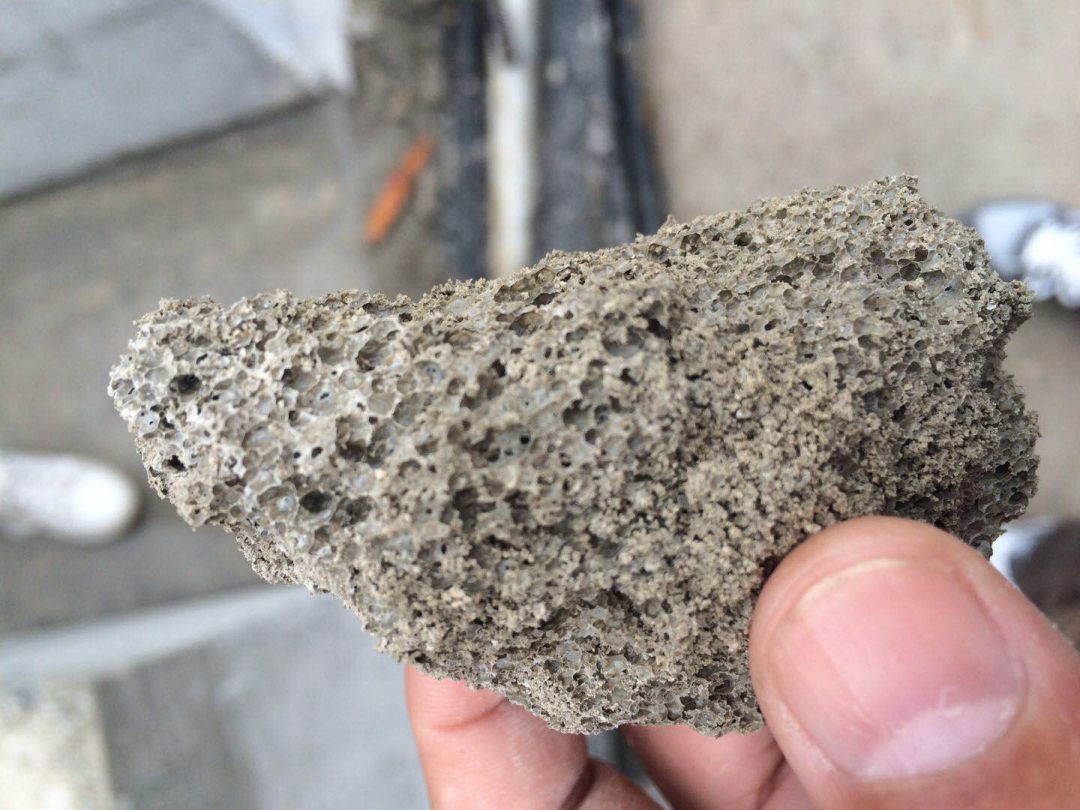
Why need use defoamers? The types of bubbles in concrete before concrete is vibrated, it contains a large number of bubbles inside, mainly including air bubbles introduced during the mixing, transportation and unloading of concrete, bubbles introduced by water reducers, and tiny bubbles introduced by air-entraining agents.
(1) Air bubbles introduced during the mixing, transportation and placement of concrete. These bubbles are relatively large in diameter, unevenly distributed and extremely unstable. They tend to coalesce into larger bubbles and are prone to bursting. Therefore, they are called unstable air bubbles. The unstable air bubbles introduced by mechanical stirring have adverse effects on both the fluidity of concrete and its mechanical properties and durability after hardening.
(2) Air bubbles introduced by water-reducing agents like polycarboxylate superplasticizer. Water-reducing agents can introduce a certain amount of air bubbles. Due to the same electrostatic repulsive force, these air bubbles are located between cement particles like ball bearings, which disperse the cement particles and thereby increase the sliding effect between cement particles. However, these air bubbles are of uneven size, irregular shape and unstable. During transportation and vibration, they often aggregate and merge into large air bubbles and eventually overflow to the surface of the concrete to form visible air bubbles, causing honeycomb and pitted surface defects.
(3) Air bubbles introduced by air-entraining agents. Air-entraining agents can create numerous fine air bubbles within concrete, with diameters ranging from 20 to 200 micrometers and evenly distributed. The liquid film on the surface of these bubbles is relatively stable. From a thermodynamic perspective, the zeta potential of the liquid film is relatively high, which can prevent bubble coalescence, making the bubbles relatively stable and less prone to rupture. This is fundamentally different from the air bubbles introduced by water-reducing agents and is beneficial to the impermeability and other durability properties of concrete. Defoamers are conducive to eliminating large air bubbles in concrete. On one hand, adding defoamers can to some extent eliminate air bubbles between concrete and formwork, effectively preventing or eliminating the formation of honeycombs and pitted surfaces on the concrete surface, resulting in a higher degree of flatness and glossiness. On the other hand, defoamers can significantly reduce the number of air bubbles within the concrete, lowering the air content and internal porosity, and thereby enhancing the mechanical properties and durability of the concrete. In concrete, defoamers mainly eliminate the air bubbles introduced by water-reducing agents. Therefore, in engineering practice, defoamers are often compounded with polycarboxylate superplasticizers to address the issue of excessive air entrainment caused by polycarboxylate superplasticizers.
The formulation of defoamer and polycarboxylate superplasticizer
Due to the high gas content, high surface activity and good defoaming property of the polycarboxylate superplasticizer mother solution, when directly used in concrete, it will cause high gas content in the concrete, many apparent bubbles and low strength, etc., thus it is necessary to add an appropriate amount of defoamer to eliminate the air bubbles in the concrete. The basic performance tests of the combination of defoamer and polycarboxylate superplasticizer generally include the compatibility of the defoamer and the superplasticizer, as well as the influence of the defoamer on the performance of the concrete.

Compatibility of Defoamers and Polycarboxylate Superplasticizer Water Reducing Agents
The difficulty in formulating defoamers with polycarboxylate superplasticizer water reducing agents lies in the compatibility issue. The compatibility between defoamers and polycarboxylate superplasticizer water reducing agents can be evaluated by testing the dissolution state of defoamers in polycarboxylate water reducing agents. If the defoamer dissolves well in the polycarboxylate superplasticizer water reducing agent and does not separate over a long period of time, the compatibility is good, and the defoamer can be compounded with the water reducing agent; otherwise, defoamers with poor compatibility cannot be compounded with water reducing agents and can only be added separately to the concrete. The compatibility of defoamers and polycarboxylate water reducing agents can also be evaluated by adding them to cement paste and testing the initial flowability and flowability loss over time of the cement paste. Defoamers with good compatibility with polycarboxylate superplasticizer water reducing agents should have no significant adverse effects on the initial flowability and flowability loss over time of the cement paste.
The Impact of Defoamers on Concrete Performance
The impact of defoamers on concrete performance is reflected in two aspects: the workability of concrete and the mechanical properties after hardening. Generally, the impact of defoamers on concrete performance is evaluated by testing the slump and slump loss, air content and strength of concrete. Defoamers that can significantly reduce the air content of concrete, have little impact on the slump and slump loss of concrete, and have a significant improvement effect on the strength of concrete are considered to have good performance.


If you need defoamers, please kindly contact with us at anytime.
Shanxi Jiankai Fine Chemicals Co.,Ltd
Email: sales@sxjkchemicals.com
Web: www. sxjkchemical.com
