

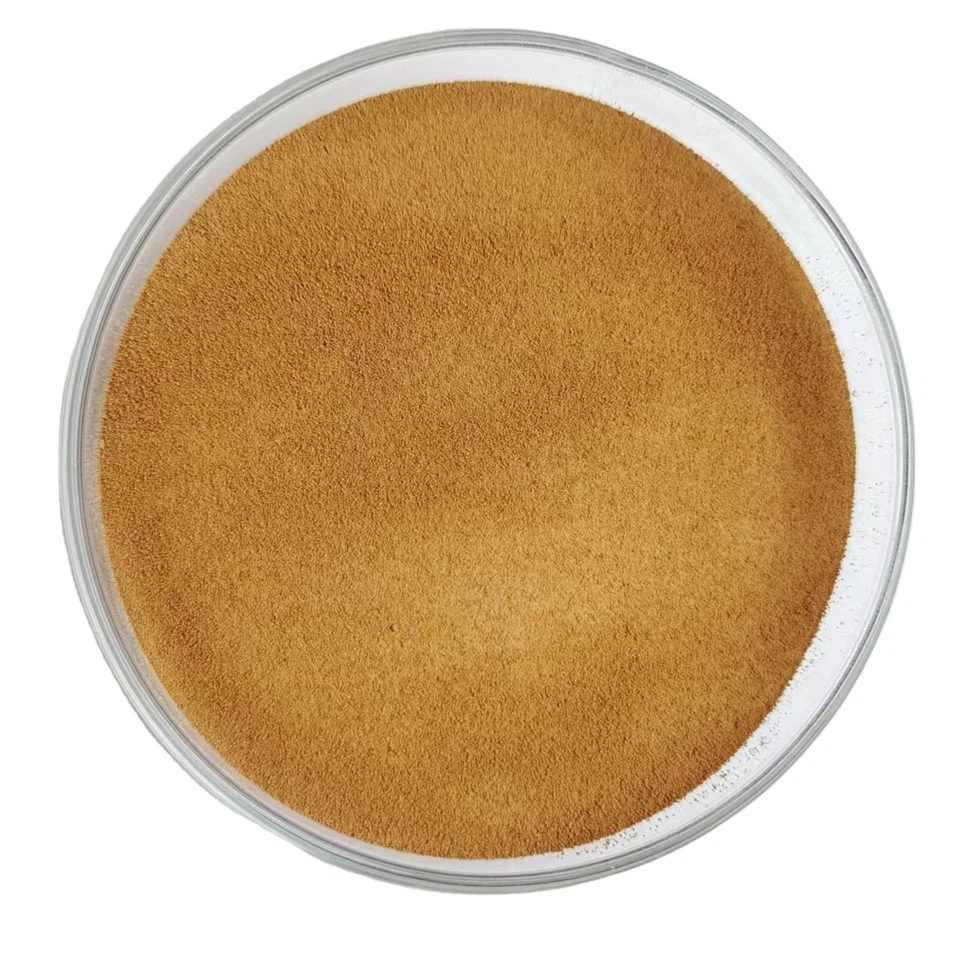
Products Description of Sodium Naphthalene Sulfonate Formaldehyde(SNF)
Sodium Naphthalene Sulfonate Formaldehyde(SNF) can improve the physical and chemical properties of concrete. It can improve concrete strength, construction speed, project quality, technology and working conditions. Sodium Naphthalene Sulfonate Formaldehyde(SNF) has become the fifth essential component material of concrete except cement, sand and water. SNF can also be used to prepare concrete of various strengths. SNF can be used as the parent material to prepare various composite series admixture products.
The important uses of water-reducing agents is to reduce the amount of water used in concrete while keeping the water-cement ratio unchanged, thereby improving the fluidity of the concrete and meeting the requirements for concrete transportation and construction. Most water-reducing agents like Sodium Naphthalene Sulfonate Formaldehyde(SNF) have a saturation dosage, and once this dosage is exceeded, the water-reducing rate will no longer increase. Seepage and segregation phenomena will occur. The size of the saturation dosage is related not only to the raw materials of the concrete but also to the concrete mix ratio to some extent.

technical grades of Sodium Naphthalene Sulfonate Formaldehyde(SNF)
Sodium Naphthalene Sulfonate Formaldehyde(SNF) is Naphthalene-based high-range water-reducing agent. SNF can be classified into high-concentration products (with Na2SO4 content < 3%), medium-concentration products (with Na2SO4 content 3% - 10%) and low-concentration products (with Na2SO4 content > 10%).
The dosage range of naphthalene-based water reducer/Sodium Naphthalene Sulfonate Formaldehyde(SNF): powder is 0.5 - 1.0% of the cement mass; solution solid content is generally 38% - 40%, and the dosage is 1.5 - 2.5% of the cement mass, with a water reduction rate of 18% - 25%.
Naphthalene-based water reducer/Sodium Naphthalene Sulfonate Formaldehyde(SNF) does not generate air entrainment, has little effect on the setting time, and can be compounded with glucose acid sodium, sugars, hydroxy carboxylic acids and salts, citric acid and inorganic retarders. Adding an appropriate air entraining agent can effectively control the loss of slump. The disadvantage of low-concentration naphthalene-based water reducer/Sodium Naphthalene Sulfonate Formaldehyde(SNF) is that the content of sodium sulfate is high. When the temperature is lower than 15℃, sodium sulfate crystallization occurs.
the specification of Sodium Naphthalene Sulfonate Formaldehyde(SNF)
| Product Name | Sodium Naphthalene Sulfonate Formaldehyde |
| Solid Content | ≥92% |
| Sodium Sulphate Content | ≤5%,≤18% |
| CAS NO. | 36290-04-7 |
| Water Reducing Rate | ≥18% |
| PH Value | 7-9 |
how to use Sodium Naphthalene Sulfonate Formaldehyde(SNF)?
When Sodium Naphthalene Sulfonate Formaldehyde(SNF) is used in liquid form, if the temperature is low (below 15℃), Na2SO4 crystals will form in the product, which seriously affects the measurement accuracy, pipeline transportation and usage effect. The saturated solubility of Na2SO4 decreases at low temperatures. For the crystals, they can be combined with other Sodium Naphthalene Sulfonate Formaldehyde (SNF) with lower sodium sulfate content. Pay attention to heating and insulation of storage tanks and pipelines.
The slump loss of concrete mixed with Sodium Naphthalene Sulfonate Formaldehyde(SNF) components is approximately 30mm to 50mm within one hour. When the temperature is high, false setting or rapid setting phenomena may occur.
In pumped concrete, the naphthalene-based admixtures/Sodium Naphthalene Sulfonate Formaldehyde(SNF) usually need to be modified by combining components such as retarders and air-entraining agents.
If the concrete is too sticky, you can replace it with a more granular base and increase the dosage of the air-entraining agent.

